RCS vs. SMS - Why Your Business Needs to Make the Switch
RCS vs. SMS: Why Your Business Needs to Make the Switch
I've been working with businesses on their customer communication strategies for years, and one thing has become crystal clear: SMS is showing its age. Don't get me wrong—it's reliable, it reaches almost everyone, and there are definitely times you need it. But if you're still relying on SMS as your primary messaging channel, you're leaving serious money on the table.
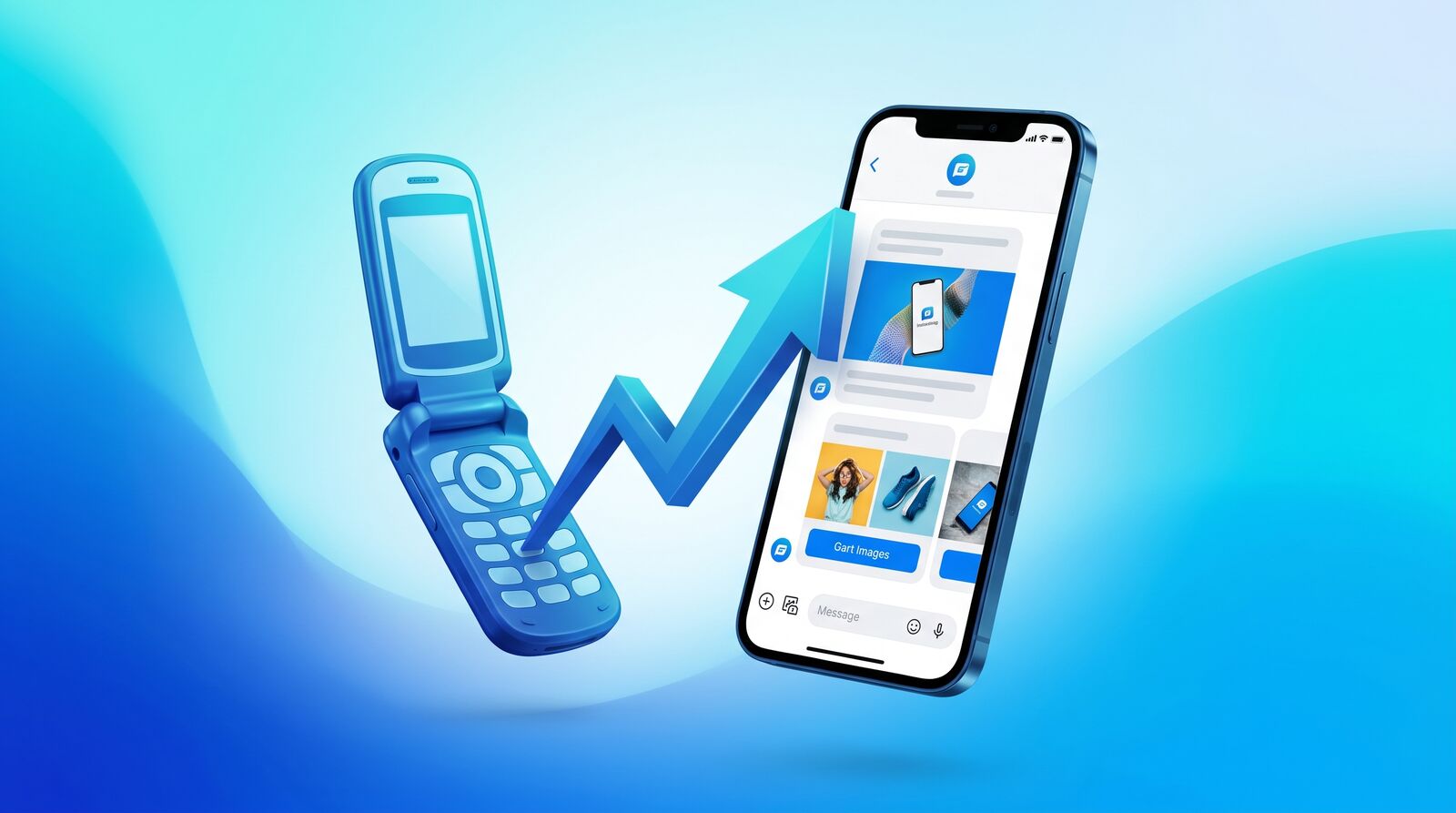
Here's the thing: customers today expect the same rich, interactive experience from messaging that they get from every other part of your business. They're used to tapping buttons, scrolling through carousels, seeing images, and getting instant feedback. Sending them a plain text message in 2025 feels like using a flip phone at a smartphone convention.
Let me walk you through what's actually changed and why it matters for your specific business.
The SMS Story: It Served Us Well, But Times Have Changed
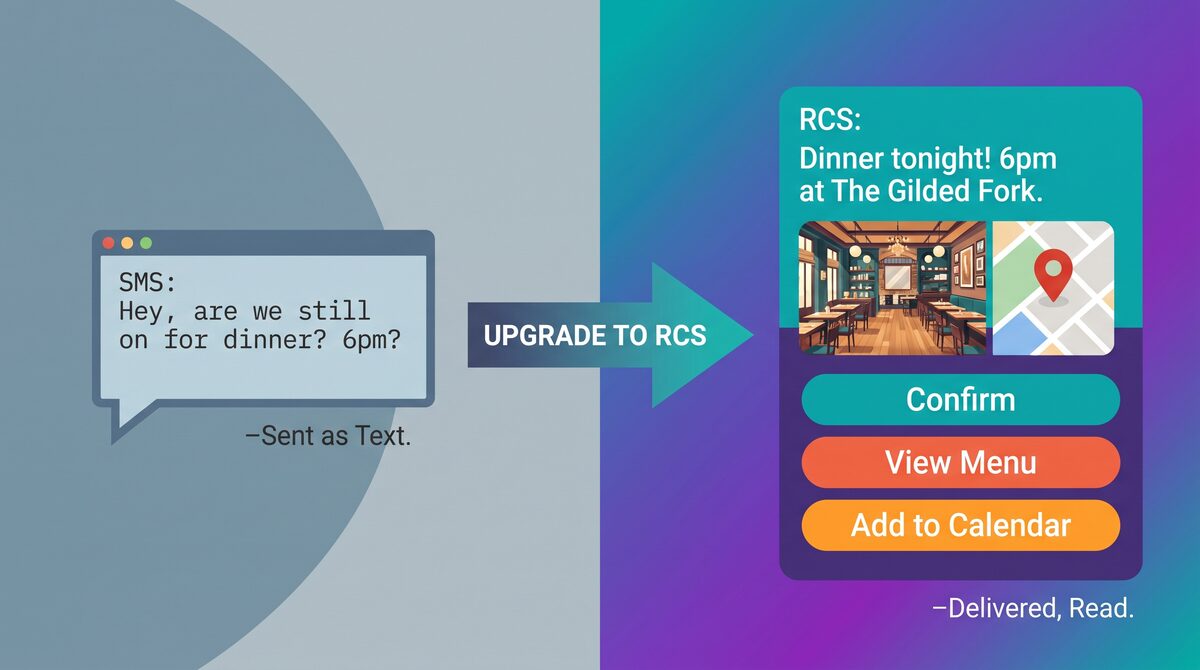
SMS burst onto the scene in 1992 as a revolution. For decades, it was the golden standard for reaching customers. Plain text, 160 characters, works on every phone ever made. That reliability is part of why it's still around.
But here's what you get with SMS:
- 160 characters of plain text (that's it)
- No pictures, no video, no links that work the way you'd want
- No read receipts—you never know if someone actually read your message
- No way to let customers interact within the message itself
- No way to show your brand personality
The adoption was universal because it had to be. Carriers controlled it tightly, and everyone's phone just... worked with SMS. That universality came at the cost of functionality.
Enter RCS: What Actually Changed
RCS stands for Rich Communication Services, and it's basically what happens when you say, "Let's build SMS for the modern era." It was designed to be the next generation of mobile messaging from the ground up.
Here's what you actually get with RCS:
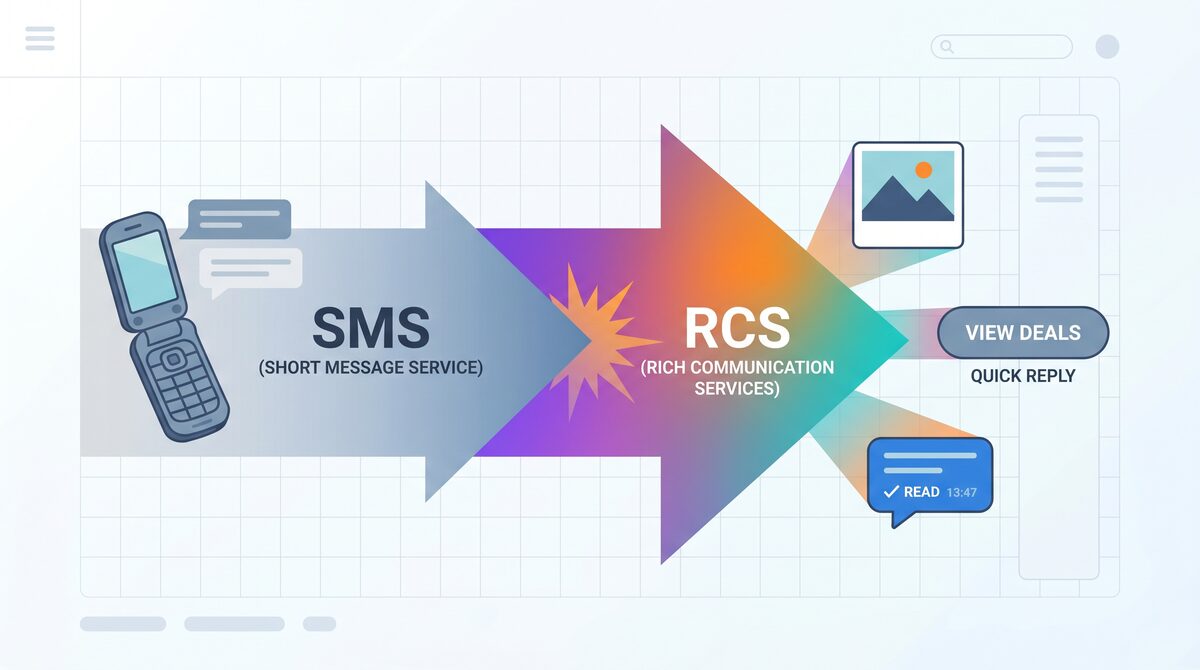
The Rich Part: Images, videos, GIFs, audio—all rendering beautifully right in the message. No need to click a link to some janky website. The content is just there.
The Interactive Part: Buttons customers can tap directly in the message. Carousels they can scroll through. Forms they can fill out. Your customer can browse products, place an order, or answer survey questions without ever leaving their messaging app.
The Smart Part: Read receipts so you know someone opened your message. Typing indicators so customers know you're responding. Geolocation capabilities so you can trigger messages based on where someone is.
The Brand Part: Your logo, your colors, your personality comes through. Messages don't look generic anymore. They look like they come from you.
The Numbers: This Isn't Theoretical
I work with data constantly, and the engagement differences between SMS and RCS are dramatic:
Open Rates: SMS gets read about 20-40% of the time. RCS? 50-80%. That's a meaningful jump.
Click-Through Rates: When people actually engage, SMS gets 2-5% of recipients to click something. RCS gets 8-15%. Some verticals see even higher.
Response Rates: This is where it gets wild. SMS gets responses from 1-3% of recipients. RCS gets 5-10%. That's a 3-5x improvement in actual interaction.
Conversion Rates: At the end of the day, do people actually buy or take action? SMS converts about 0.5-2% of recipients. RCS converts 2-8%. If you're sending messages to 100,000 people, that difference adds up fast.
I've watched e-commerce companies recover abandoned shopping carts at 25-30% with RCS messages, compared to 10% with SMS. I've seen hospitality businesses increase upsell rates by 30-40%. Retail promotions drive foot traffic increases of 40-60%.
These aren't outliers. They're consistent patterns I see across industries.
Where RCS Actually Shines: Real Industry Examples
E-Commerce
You just launched a flash sale. With SMS, you send text: "SALE NOW. Click link." Most people don't click. With RCS, you send a carousel of your best-selling products right in the message, with "Shop Now" buttons for each one. People can browse and buy without leaving messages.
Customer Service
Customer has a support ticket. With SMS, you send: "Ticket #12345 updated. Status: in progress." They wonder what actually changed. With RCS, you send details and images of the issue, a progress bar, and buttons to request a call or chat with support.
Healthcare
Appointment reminder. SMS: "You have an appointment tomorrow at 2 PM." RCS: Same message plus a calendar button to add it to their phone, a map to your location, and buttons to confirm, reschedule, or ask questions.
Financial Services
Account alert. SMS: "Alert: Large transaction detected." RCS: Same alert plus transaction details, the merchant, the location, and buttons to report fraud or approve the transaction right there.
Retail
Inventory check. SMS: "Check your store for product availability. Click link." RCS: Real-time inventory across nearby stores with directions buttons and "Reserve Now" buttons.
The Adoption Question: But How Many People Actually Have RCS?
This is the real question, and it's evolved dramatically. Three years ago, RCS adoption was spotty. Today?
Android devices (which is 70% of the global market): 75%+ support RCS through Google Messages. That's not 75% of people you reach; that's 75% of a huge installed base.
Growth rate: RCS adoption is growing at 40% compound annual growth rate. That's real momentum.
Geographic variation: In developed markets (US, UK, Germany, Canada), adoption is already 60%+. In developing markets, it's growing rapidly as newer devices become the standard.
Carrier support: Every major carrier (Verizon, AT&T, T-Mobile, Deutsche Telekom, etc.) is investing heavily in RCS infrastructure.
Here's the thing though: even if only 40% of your audience has RCS, you'd be foolish to ignore it. You can send RCS to people who support it, and the message automatically falls back to SMS for everyone else. Best of both worlds.
The Strategic Way Forward: You Don't Have to Choose
Smart businesses aren't replacing SMS with RCS. They're using both strategically.
Send SMS when: You need guaranteed delivery to absolutely everyone. Critical security alerts. Time-sensitive information that can't wait for a fallback. Reaching an older demographic. Budget is extremely tight.
Send RCS when: Engagement and conversion matter. You want customer interaction. You're doing marketing or promotional messaging. Visual content makes sense. The message is about selling something or getting action.
The Smart Setup: Segment your audience. People on RCS-capable devices get rich messages. People on older devices or who haven't upgraded get SMS. Track performance separately. Over time, you'll see your RCS volume grow naturally as device adoption increases.
The beauty is you don't need to bet everything on RCS growing fast. You can start with a portion of your audience, measure results, and expand based on what the data shows.
The Cost Question: Is This Going to Break the Budget?
SMS typically costs $0.005 to $0.05 per message, depending on volume and carrier. RCS is usually in the same ballpark—sometimes slightly higher, sometimes the same. At volume, RCS often costs similar or less than SMS when you factor in the higher engagement reducing your overall message volume needed.
More importantly: the ROI completely changes the math. If RCS costs 10% more but drives 100% more conversions, that's a slam dunk financially.
Device Support: What Actually Happens on iPhones?
This is the one limitation I'd be lying if I didn't mention. Apple hasn't implemented RCS natively in iMessage the way Android has.
Here's what actually happens: if you send an RCS message to an iPhone user, it falls back to SMS automatically. It's seamless. The customer never knows. From your perspective, you sent the message; it got delivered. The customer gets a text instead of a rich message.
Is that ideal? Not really. But given that SMS is a fallback position that works perfectly fine, and given the engagement lift you get from the 70%+ of people on Android who do support RCS, it's absolutely worth it.
Making the Business Case
Let me give you a concrete example. Say you're an e-commerce company with 100,000 active customers sending 50,000 promotional messages per month.
Current SMS baseline:
- 50,000 messages/month at $0.01 per message = $500/month platform cost
- 1.5% conversion rate = 750 conversions
- $50 average order value = $37,500 in revenue
- Net: $37,000/month = $444,000/year
Move 20% to RCS:
- 10,000 RCS messages at slightly higher per-message cost, but same platform fee budget
- 40,000 SMS messages as fallback
- RCS conversion rate: 3% (2x improvement) = 300 conversions = $15,000
- SMS conversion rate: 1.5% = 600 conversions = $30,000
- Total revenue: $45,000/month = $540,000/year
- Additional revenue: $96,000/year
Implementation cost? Maybe $30,000-50,000 first year including setup, training, integration.
Payback period? 3-6 months.
That's not me being optimistic. That's what I've seen play out across multiple businesses.
The Reality Check: When You Might Want to Wait
I believe in RCS, but I'm also realistic. If your situation looks like this, you might want to hold off:
- Your customers are primarily on older devices. If your audience is feature phones and ancient Android, RCS adoption is still low.
- SMS is already performing incredibly well. Some businesses have cracked the SMS code and get 10%+ engagement. In that case, optimization and small improvements might matter more than switching channels.
- You're primarily sending transactional/security messages. SMS's reliability is actually an advantage here. Don't optimize for engagement; optimize for guaranteed delivery.
- Budget is completely locked down. If implementation cost just isn't available, focus on squeezing more from what you have.
But for most growing e-commerce, hospitality, retail, and financial services businesses? RCS is worth serious consideration.
Next Steps: If This Resonates
If you're thinking, "This sounds like something we should explore," here's what I'd recommend:
- Look at your customer base. What percentage uses modern Android devices with Google Messages? What about your mobile OS breakdown?
- Calculate your baseline engagement. How many people open your promotional messages? How many click? How many convert?
- Project the impact. Even conservative assumptions (2x engagement lift) show meaningful financial upside.
- Start small. Don't migrate everything at once. Test RCS with a segment of your audience first. Measure it carefully. Let the data guide whether to expand.
- Get the right partner. Integration should be straightforward, but you need a platform and team that understand both SMS fallback strategy and RCS best practices.
I've helped dozens of businesses through this transition, and I haven't met one yet who said, "We wish we'd stayed with SMS." The engagement improvements are real. The customer experience improvements are real. The financial impact is real.
The question isn't whether RCS is the future of business messaging. It clearly is. The question is when you want to start capturing that advantage.
If you want to discuss what this might look like specifically for your business, schedule a consultation.
Find out if you're ready for RCS
Take our free 5-minute readiness assessment and get personalized recommendations for your business.
Tim Mushen
Experienced RCS messaging specialists sharing insights and best practices.
Related Articles

Strategy
RCS Adoption Challenges - And How to Overcome Them
Overcome carrier delays, fragmentation, and cost objections—practical fixes for marketers and operators planning an RCS rollout.
Strategy
RCS Best Practices - What Actually Works
Proven RCS frequency, timing, and content practices for marketers—what works, what to avoid, and how to scale when you're ready.