
RCS Adoption Challenges - And How to Overcome Them

RCS Adoption Challenges—And How to Overcome Them
RCS is a game-changer, but implementing it isn't always smooth. I've seen businesses get excited about RCS, start the implementation, hit obstacles, and give up.
These obstacles are predictable, and they're solvable. Here's what actually goes wrong and how to handle it.
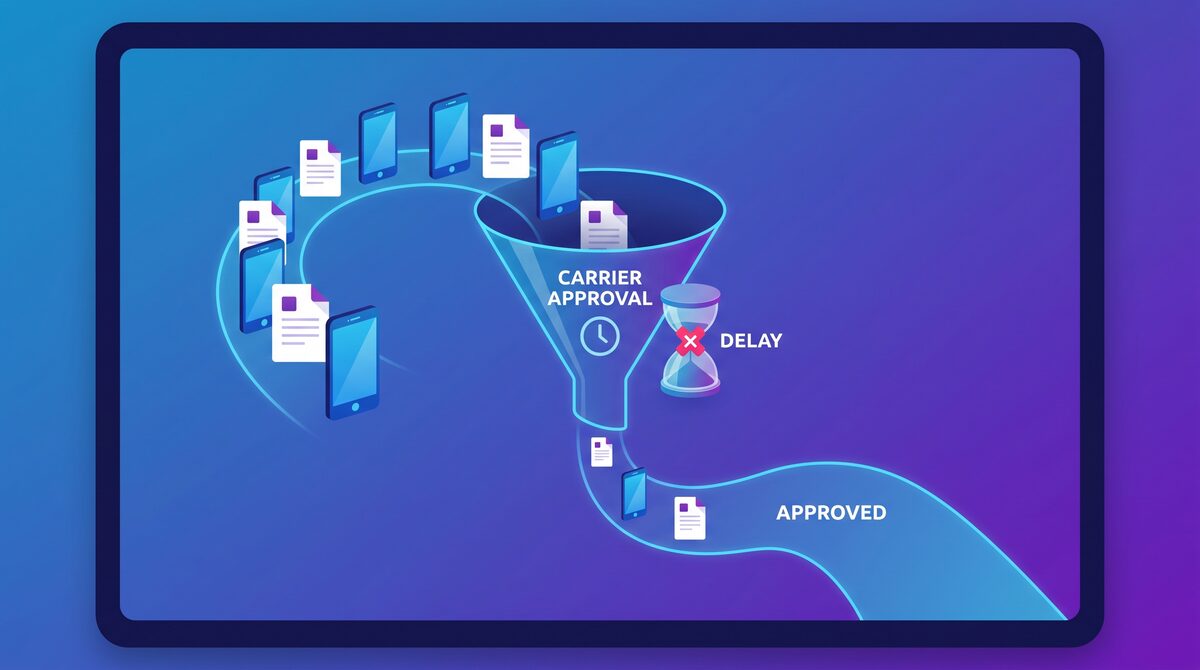
Challenge 1: Carrier Approval Delays
The problem: Before you can send RCS messages, you need to register with carriers and get your "business verified." This takes time—usually 2-4 weeks.
What makes it worse: There's no single process. Each carrier has its own requirements, documentation, and review timeline.
How to overcome it:
- Start early. If you're planning to launch RCS in Q2, start the carrier approval process in Q1. Build in buffer time.
- Work with your provider. Your RCS provider should handle most of this for you. If they're not offering to shepherd you through the process, that's a red flag.
- Prepare documentation early. You'll need:
- Business registration documents
- Official company identification
- Brand trademarking information (if applicable)
- Use case documentation (what messages you'll send)
- Test with your provider first. Many providers have sandbox environments where you can test messaging before going through carrier approval.
- Communicate timeline to stakeholders. "We're starting carrier approval now. It takes 3-4 weeks. We'll be live mid-month." Sets expectations.
This isn't optional. It's required. Plan for it.
Challenge 2: Device Fragmentation
The problem: RCS adoption varies wildly by device, manufacturer, and carrier.
- Google Pixel devices: 95%+ RCS support
- Samsung mid-range: 80%+ RCS support
- iPhone: 0% RCS support (falls back to SMS)
- Older Android: 40-50% RCS support
- Carriers vary: Some carriers prioritize RCS rollout; others are slower
Result: Your actual RCS reach might be 40-50% even though "75% of Android users have RCS" sounds better.
How to overcome it:
- Test your actual reach early. Don't guess. Send test messages to customers and measure actual RCS delivery rate. That's your baseline.
- Segment by device. Not all Android devices have RCS. Understand your specific audience's device mix.
- Plan for SMS fallback. Assume 20-30% of your audience will get SMS instead of RCS. Make sure your SMS fallback is good.
- Gradual rollout. Start with customers who have confirmed RCS capability. Expand as you grow confidence.
- Monitor by demographic. Adoption varies by age, region, carrier. Older demographics have lower RCS adoption. Adjust strategy accordingly.
The reality: You won't get 100% of your audience on RCS. That's okay. Even 50-60% RCS reach is valuable because those users engage 3-5x higher than SMS baseline.
Challenge 3: Cost Concerns
The problem: "RCS costs more than SMS. We don't want to spend extra."
Reality check: RCS usually costs the same or slightly more per message than SMS. But since engagement is 3-5x higher, cost-per-engagement is actually lower.
But some CFOs look at the per-message cost and balk.
How to overcome it:
- Show the ROI math. "RCS costs 15% more per message but drives 200% more conversions. That's a 140% improvement in cost-per-conversion."
- Start small. Don't convert all traffic to RCS overnight. Convert 20% of your volume. Prove the ROI. Then expand.
- Point out that SMS isn't free to develop. They had to build SMS infrastructure, train teams, create templates. RCS is an addition to your stack that drives more value from the same audience.
- Compare to other channels. Email is cheap but has 2-5% CTR. RCS has 8-15% CTR. Push notification can cost $0.001-0.003 per message. RCS at $0.01-0.02 is competitive.
- Highlight the time value. RCS converts faster (24-48 hours vs. email over a week). Faster conversion means faster cash flow.
For most businesses, the RCS cost premium disappears after factoring in engagement lift. But you need to make that argument clearly.
Challenge 4: Technology Integration
The problem: Your RCS provider needs to integrate with your e-commerce platform, CRM, analytics, etc. This isn't always simple.
You've got:
- Shopify or Magento for e-commerce
- Salesforce or HubSpot for CRM
- Segment or Mixpanel for analytics
- Zendesk or Help Scout for support
Does your RCS provider integrate with all of these? Probably not all.
How to overcome it:
- Choose your RCS provider strategically. Before picking one, check their integrations. Do they support your tech stack?
- Zapier/middleware solutions. If direct integration doesn't exist, consider tools like Zapier or Make. They can connect your RCS platform to other systems.
- Accept some manual work initially. If a direct integration doesn't exist, you might manually run CSV uploads for first week while you build something more elegant.
- Budget for integration work. This might cost $5,000-15,000 in engineering time. Plan for it.
- Use APIs. If integrations don't exist, most RCS providers have APIs. Your engineering team can build custom integration.
The integration problem is real but solvable. Don't let it stop you.
Challenge 5: Team Expertise Gaps
The problem: Your marketing team understands email and SMS. They don't understand RCS's unique capabilities.
You end up with RCS messages that look like SMS with images. That's not leveraging what makes RCS special.
How to overcome it:
- Train your team. Spend a day on RCS strategy, capabilities, best practices. It's not hard, but people need context.
- Hire or consult. If you have budget, bring in someone who knows RCS. They'll save months of learning curve.
- Start simple. Don't try to use all RCS features at once. Start with text + image + button. Master that. Then add carousels, forms, etc.
- Create templates. Build message templates for common use cases (cart abandonment, product recommendation, etc.). Make it easy for non-experts to use RCS correctly.
- Iterate quickly. Your first few campaigns won't be perfect. That's fine. Learn and improve.
Expertise gaps are temporary if you invest in training and learning.
Challenge 6: Analytics and Measurement
The problem: You're used to email analytics and SMS metrics. RCS metrics are different and sometimes more complex.
How do you measure success? What's a "good" open rate? How do you attribute conversions?
How to overcome it:
- Define baseline metrics first. Before launching, understand your SMS baseline for the same audience and message type. Use that as your comparison.
- Set up proper tracking. Make sure each RCS message has a unique identifier. Track delivery, opens, clicks, conversions.
- Create a dashboard. Consolidate RCS metrics with conversion data so you can see the full picture.
- Benchmark against industry. E-commerce RCS typically gets 60%+ open rate and 10%+ CTR. Healthcare gets 70%+ open rate. Know what healthy looks like for your industry.
- Focus on conversion, not just engagement. It's nice that RCS has high open rates. But does it drive business results? That's what matters.
Measurement is solvable if you set it up from day one.
Challenge 7: Maintaining Message Quality
The problem: You launch RCS with great content. Three months in, you're on autopilot sending lower-quality messages.
Message quality declines. Engagement drops. You think RCS "doesn't work anymore."
Actually, you stopped caring about quality.
How to overcome it:
- Create a quality checklist. Before sending any RCS campaign:
- Is the offer compelling?
- Are the images high quality?
- Is the copy clear and conversational?
- Is there a clear call-to-action?
- Does it add value to the customer?
- Regular audits. Monthly, review the last 10 campaigns. Which performed well? Why? Which flopped? Why?
- Refresh content regularly. After 3 months, old creative gets stale. Refresh images, copy, offers.
- Segment and personalize. Don't send the same message to everyone. Tailor to customer segment.
- Test constantly. Different times, different copy, different offers. Keep learning what works.
Quality discipline is the difference between successful RCS programs and ones that fizzle.
Challenge 8: Regulatory Compliance
The problem: RCS is regulated like SMS (TCPA in the US, similar laws elsewhere). Screw this up and you face fines.
Requirements:
- Explicit opt-in (written consent)
- Easy opt-out (one-tap unsubscribe)
- No spamming
- No spoofing (don't pretend to be someone else)
- Respect message timing rules
How to overcome it:
- Get legal review. Your RCS program should be reviewed by legal counsel familiar with TCPA and local telecom law.
- Document consent. Keep records of customer opt-ins. Show that they explicitly agreed to RCS.
- Easy opt-out. Include "Stop messages" or "Unsubscribe" option in every campaign. Make it one-tap.
- Monitor for complaints. If customers complain about RCS spam, respond immediately and unsubscribe them.
- Work with compliant providers. Your RCS provider should have compliance built-in and should provide guidance.
Compliance isn't optional. Do it right from day one.
Challenge 9: Executive Buy-In
The problem: You're excited about RCS. Your CFO is skeptical. "Why should we spend money on RCS when SMS is working fine?"
How to overcome it:
- Lead with ROI. "This costs $40,000 to implement and pays back in 3 months."
- Run a pilot. Don't ask for full commitment. Ask for $10,000 for a test with 10,000 customers. Show results.
- Benchmark against competitors. "Our competitors are implementing RCS. If we wait, we'll fall behind."
- Show market data. RCS adoption is growing 40% annually. Carriers are investing billions. This isn't a fad.
- Focus on customer value. "Our customers get a better experience. Engagement rates improve. Brand perception improves." Focus on customer benefit, not just company benefit.
- Get a champion. Find someone senior who believes in RCS. Have them champion it internally.
Executive buy-in is about education and proof. Give them both.
The Common Thread
Most RCS implementation obstacles aren't actually problems with RCS. They're problems with execution, planning, and expectation-setting.
RCS is proven to work. The issue is usually how teams implement RCS, not whether RCS itself works.
Solution: Plan thoroughly, start small, measure carefully, iterate constantly.
That's how successful RCS programs get built.
Ready to overcome the obstacles and launch RCS properly?
Find out if you're ready for RCS
Take our free 5-minute readiness assessment and get personalized recommendations for your business.
Tim Mushen
Experienced RCS messaging specialists sharing insights and best practices.
Related Articles

Strategy
RCS Best Practices - What Actually Works
Proven RCS frequency, timing, and content practices for marketers—what works, what to avoid, and how to scale when you're ready.

Strategy
The RCS Business Case - ROI That Actually Makes Sense
Build an RCS business case execs approve—costs, ROI ranges, and payback framing for marketers and operators seeking buy-in.