RCS vs. Email vs. Push Notifications - Channel Strategy
RCS vs. Email vs. Push Notifications: Channel Strategy
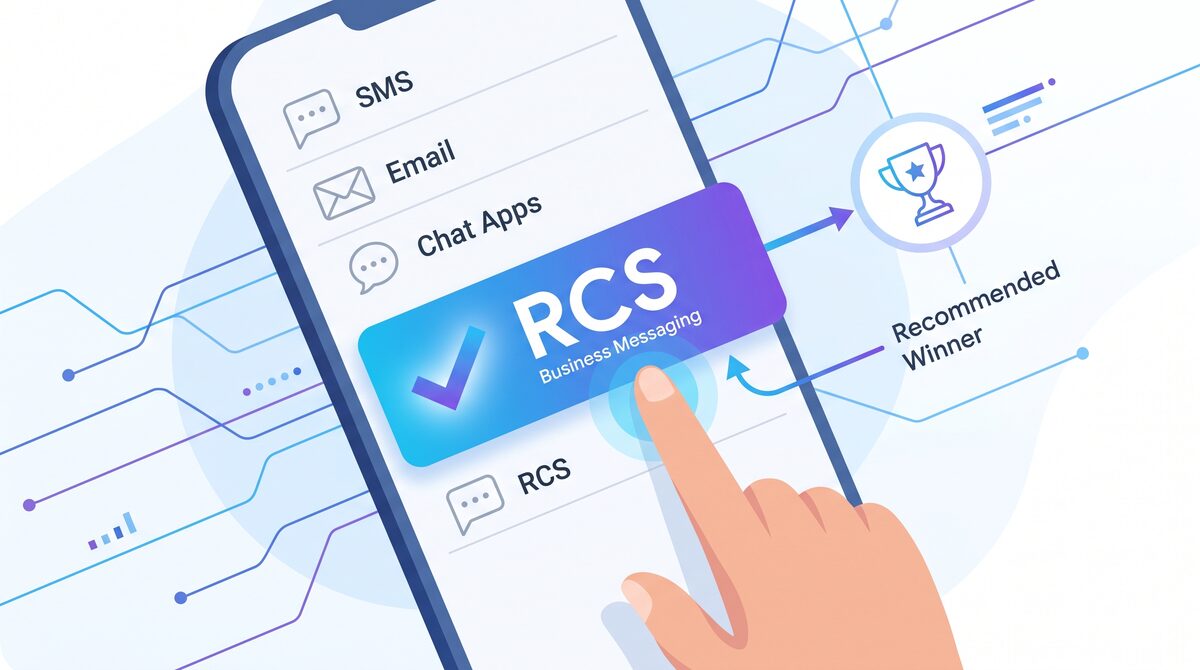
Every business has multiple communication channels. Email, push notifications, SMS, RCS. The question isn't which one is best—they're all best for something specific.
The question is: how do you use each channel strategically so they work together instead of competing?
The Channels Compared
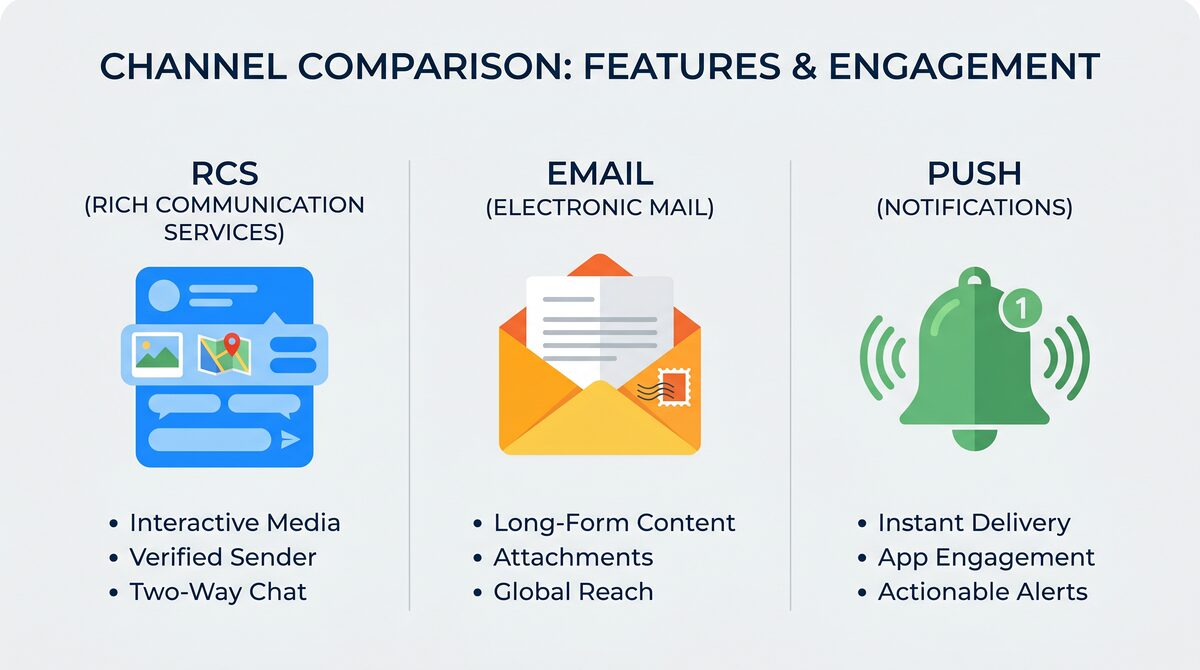
Let's start with a head-to-head comparison:
RCS:
- Reach: 75% of Android users (growing)
- Open rate: 50-80%
- Click-through rate: 8-15%
- Engagement: 2-way conversation
- Latency: Instant
- Cost: ~$0.01-0.02 per message
- Best for: Immediate action, rich engagement
Email:
- Reach: 98%+ of customers
- Open rate: 15-25%
- Click-through rate: 2-5%
- Engagement: One-way, can include lots of content
- Latency: Minutes to hours
- Cost: Essentially free at scale (infrastructure)
- Best for: Detailed information, content-heavy
Push notifications:
- Reach: Mobile app users only
- Open rate: 40-70%
- Click-through rate: 15-25%
- Engagement: One-way, limited content
- Latency: Instant
- Cost: Essentially free (built into app)
- Best for: Urgent updates, app-specific actions
SMS:
- Reach: 99%+ of users
- Open rate: 20-40%
- Click-through rate: 2-5%
- Engagement: One-way, very limited content
- Latency: Instant
- Cost: ~$0.005-0.05 per message
- Best for: Critical alerts, maximum reach
The Decision Tree: Which Channel for What
Trying to drive immediate action (next 24 hours)? → RCS or SMS (instant delivery) or Push (if they're in your app) → Not email (too slow)
Need to reach everyone without exception? → SMS (99%+ reach) → Email (98%+ reach) → Not RCS (75% reach) or Push (app users only)
Want two-way conversation? → RCS (people can reply with buttons or text) → Push is one-way → Email is technically one-way (replies exist but aren't your primary use case) → SMS is one-way
Need to include lots of detail/content? → Email (can send long form, multiple sections) → RCS can do this but it's not ideal (mobile-focused) → SMS and Push are too limited
Want high engagement/click-through? → RCS (8-15% CTR) or Push (15-25% CTR if you have the app) → Email (2-5% CTR) → SMS (2-5% CTR)
Have a tight budget?
→ Email (basically free after initial setup)
→ Push (free if you built the app)
→ RCS ($0.01-0.02 per message)
→ SMS ($0.01-0.05 per message, depending on volume)
Real-World Multi-Channel Strategy
Here's how I actually recommend using channels together:
Use Case: Product Launch
24 hours before:
- Push notification to app users (they see it first, feel special)
- Email to entire list (lots of detail about what's launching)
Launch day:
- RCS to high-value customers (rich product showcase, immediate action)
- SMS to everyone else (keep it simple, link to full details)
- Push notification to app users (instant notification when live)
24 hours after:
- Email follow-up to people who didn't click
- RCS follow-up with personalized recommendations
- Push reminder to app users who haven't explored yet
Why this mix: You're using each channel for its strength. Push for instant app engagement. Email for comprehensive details. RCS for rich engagement and conversion. SMS for reliable reach.
Use Case: Abandoned Cart Recovery
1 hour after abandonment:
- Push notification (immediate reminder if in app)
- Nothing else yet (too early)
3 hours after:
- RCS with product images and one-tap checkout (they remember what they wanted)
24 hours after:
- Email with reminder, maybe discount incentive
Result: You're hitting them at different times with different channels. This multi-touch approach recovers way more carts than single-channel.
Use Case: Seasonal Campaign
Phase 1 - Awareness:
- Email blast (reach everyone, introduce the campaign)
- Push to app users (highlight featured products)
- RCS to high-engagement segment (rich carousel with top products)
Phase 2 - Engagement:
- RCS targeted to recent browsers (show them products they viewed)
- Email to clickers (more detailed offer)
- SMS to non-clickers (simple reminder)
Phase 3 - Conversion:
- RCS special offer to cart abandoners
- Push flash sale notification
- Email last-chance message
Result: Different customers see different channels based on their engagement. You maximize reach and engagement.
When to Use RCS Instead of Other Channels
Use RCS instead of email when:
- You need immediate action, not eventual consideration
- Visual presentation matters (products, offers need to look good)
- You want conversion within 24 hours
- Your audience is primarily mobile
- You want to avoid email clutter (inbox fatigue is real)
Use RCS instead of SMS when:
- You want richer engagement and interaction
- The message has visual components
- You want read receipts and engagement tracking
- Your message is about offerings, not critical alerts
Use RCS instead of push when:
- Your reach would be limited (only app users have push)
- Your audience doesn't have your app
- You want communication to work without requiring app download
When to Stick with Other Channels
Stick with email when:
- You need comprehensive information
- You want evergreen content (archived for later reference)
- You're building a list (email is owned; RCS/SMS are rented)
- Your audience expects email communication
Stick with SMS when:
- You need 99%+ reach
- It's critical (security code, fraud alert, emergency)
- Budget is extremely constrained
- You're reaching an audience that doesn't use modern phones
Stick with push when:
- Your primary goal is to drive app engagement
- You want to encourage app usage
- Your content is app-specific
- You don't want to pay per message
The Math: Multi-Channel ROI
Let's model a customer journey with single-channel vs. multi-channel:
Single channel (email only):
- Send 10,000 emails
- 20% open rate
- 5% CTR
- 2% conversion
- 200 conversions
Multi-channel:
- Email: 10,000 sent, 20% open, 5% CTR, 1.5% conversion = 150 conversions
- RCS: 6,000 sent (60% of audience with RCS), 60% open, 12% CTR, 4% conversion = 288 conversions
- SMS: 10,000 sent, 30% open, 3% CTR, 1% conversion = 30 conversions
- Push: 3,000 sent (30% have app), 50% open, 20% CTR, 3% conversion = 18 conversions
- Total: 486 conversions (2.4x improvement)
The reason: different people respond to different channels at different times. The customer who ignores email might respond to RCS. The person on the go might open push. The SMS audience includes people who don't check email regularly.
You're not cannibalizing channels; you're capturing the people that other channels miss.
Avoiding Channel Fatigue
The risk of multi-channel: customers get overwhelmed.
Rules to prevent fatigue:
- Different content per channel. Don't send the exact same message via email, RCS, and SMS. Each has a version optimized for that channel.
- Respect frequency caps. If someone gets an email, wait 24-48 hours before RCS. Don't bombard them within the same day.
- Segment by channel preference. Some customers prefer email. Some prefer push. Let them choose (when possible) and respect it.
- Use sequential timing, not simultaneous. Send email first. After 24 hours if they haven't converted, send RCS. After 48 hours, send SMS. This is a journey, not a bombardment.
- Measure unsubscribe/opt-out rates per channel. If RCS opt-outs spike, you're over-using it. Back off.
Attribution in Multi-Channel Campaigns
Here's the tricky part: when you use multiple channels, who gets credit for the conversion?
Customer journey:
- Gets email (opens, doesn't click)
- Gets RCS 24 hours later (clicks)
- Lands on website, converts
Did email get them interested? Did RCS push them over? Or would they have converted anyway?
This is why attribution is complex. But here's what I recommend:
- Track each touchpoint. Know which channels your customers interacted with.
- Use last-click attribution as a baseline. RCS gets credit (it was the last interaction).
- But acknowledge that email influenced them. It did. They didn't convert from email, but they also wouldn't have converted without it.
- Model contribution. If email had 70% of conversions, RCS had 20%, SMS had 10%, the channels are supporting each other.
- Optimize based on cost-efficiency. Email is cheapest per conversion. RCS has highest engagement. SMS has highest reach. They're complements, not competitors.
The Winning Strategy
Here's what actually works:
- Email as the base layer. Reach everyone, provide comprehensive information, build your owned list.
- RCS as the engagement layer. Drive action from your most valuable customers and hottest segments.
- SMS as the reach layer. Hit everyone with critical information or essential offers.
- Push as the app layer. Drive app engagement and urgent notifications.
- Segment by channel preference. Not everyone wants everything through every channel.
- Sequence smartly. Not all at once. Strategic timing maximizes impact.
Each channel has a job. Email builds awareness and provides detail. RCS drives engagement and conversion. SMS ensures reach. Push drives app engagement. When they work together, your conversion rate multiplies.
When people say "we tried RCS and it didn't work," usually what they mean is "we used RCS in isolation without a channel strategy." Of course it underperformed. That's not an RCS problem. That's a strategy problem.
Ready to build a real multi-channel strategy?
Find out if you're ready for RCS
Take our free 5-minute readiness assessment and get personalized recommendations for your business.
Tim Mushen
Experienced RCS messaging specialists sharing insights and best practices.
Related Articles
Strategy
RCS Adoption Challenges - And How to Overcome Them
Overcome carrier delays, fragmentation, and cost objections—practical fixes for marketers and operators planning an RCS rollout.
Strategy
RCS Best Practices - What Actually Works
Proven RCS frequency, timing, and content practices for marketers—what works, what to avoid, and how to scale when you're ready.