
RCS Personalization Strategies That Drive Conversion
RCS Personalization Strategies That Drive Conversion
RCS's true power isn't in the rich media. It's in the ability to personalize that rich media at scale.
A generic carousel of products gets 5-8% CTR. A carousel showing products specifically relevant to that individual customer? 15-20% CTR.
That's not magic. That's personalization. And it's the difference between a decent RCS program and one that drives serious business value.
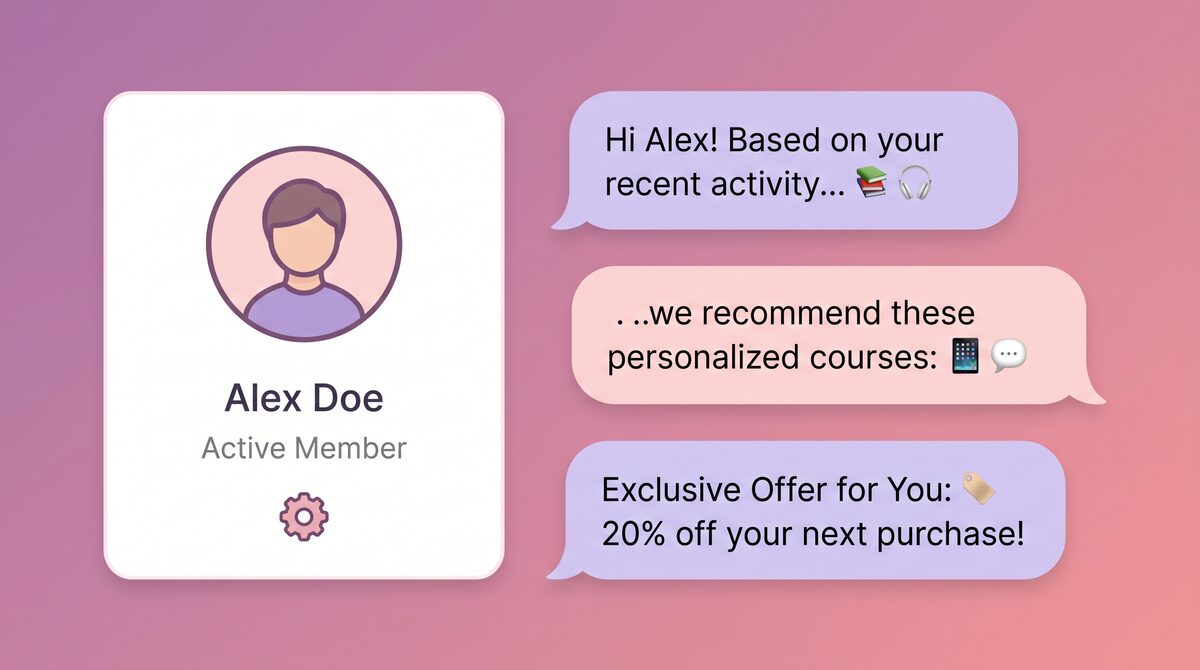
The Personalization Layers
Layer 1: Basic Segmentation
Segment by the simplest, most obvious factors:
Purchase history:
- "Bought jackets before" → Show jacket promotions
- "Never bought shoes" → Show shoe promotions with first-time buyer incentive
- "High-value customer" → Show premium products with special offers
Engagement level:
- High engagers → More frequent messages, richer content
- Low engagers → Only high-value offers, simpler messages
- Never engaged → Re-engagement campaigns only
Device/platform:
- iPhone users → Link to email or web (no native RCS)
- Android RCS users → Full rich experience
- SMS-only → Keep it simple
Geographic:
- "In California" → Show local promotions
- "Within 5 miles of our downtown store" → Show local inventory and store info
- "UK customer" → Price in GBP, local offers
This is day-one personalization. Most businesses don't even do this. Start here.
Layer 2: Behavioral Personalization
Dig deeper into what the customer has actually done:
Browsing history:
- "Viewed blue jackets" → Show blue jackets in RCS message
- "Browsed shoes multiple times" → Shoe recommendation with discount
- "Added to cart but didn't buy" → Cart recovery with that specific product
Purchase recency:
- "Bought 6 days ago" → Send follow-up survey or care instructions
- "Bought 3 months ago" → Time for replenishment? Show complementary products
- "Haven't bought in 6 months" → Win-back campaign with special offer
Interaction with emails:
- "Opens all emails" → Can send more RCS (they're engaged)
- "Ignored last 3 emails" → RCS should be higher-value offers only
- "Clicked email links" → Show related products in RCS
Support interactions:
- "Had a return" → Follow-up RCS on how the replacement is working
- "Contacted support" → RCS acknowledging the issue and offering help
- "Left review" → Personalized thank you RCS
This is the sweet spot. With layer 1 + layer 2, you're personalizing meaningfully without getting creepy.
Layer 3: Predictive Personalization
Use machine learning and data analysis to predict what this customer wants:
Purchase prediction:
- Model suggests "70% likelihood this customer will buy shoes in next 30 days"
- Send RCS showcasing new shoe arrivals
Churn prediction:
- Model identifies customers showing signs of disengagement
- Send RCS with special offer to win them back before they actually leave
Next-best-action:
- System recommends "shoes" or "accessories" as next purchase
- Personalize RCS recommendations based on that
Price sensitivity:
- Data shows this customer responds to discounts
- Show discounted products in RCS
- Other customer doesn't care about price; show premium products
Optimal timing:
- This customer engages most at 7 PM Thursday
- Send RCS then instead of random time
- Another customer engages at 10 AM Monday
- Send them then
This requires data science resources, but tools like Segment, Mixpanel, or your RCS provider can help.
Building the Data Infrastructure
To personalize effectively, you need clean data:
Customer data sources:
- E-commerce platform (purchase history, product interests, order value)
- CRM (interaction history, customer notes, communication preferences)
- Email platform (opens, clicks, engagement patterns)
- Web analytics (pages visited, time on site, products viewed)
- Mobile app (app behavior, in-app purchases, feature usage)
- Support system (tickets, complaints, resolutions)
Data integration:
- Use CDP (Customer Data Platform) to consolidate all data in one place
- Keep it current (updates should happen automatically)
- De-duplicate and clean data regularly
- Ensure you have permission to use the data
Tools:
- Segment, mParticle, or Treasure Data for CDP
- Your RCS provider's data connectors
- Custom APIs to pipe data between systems
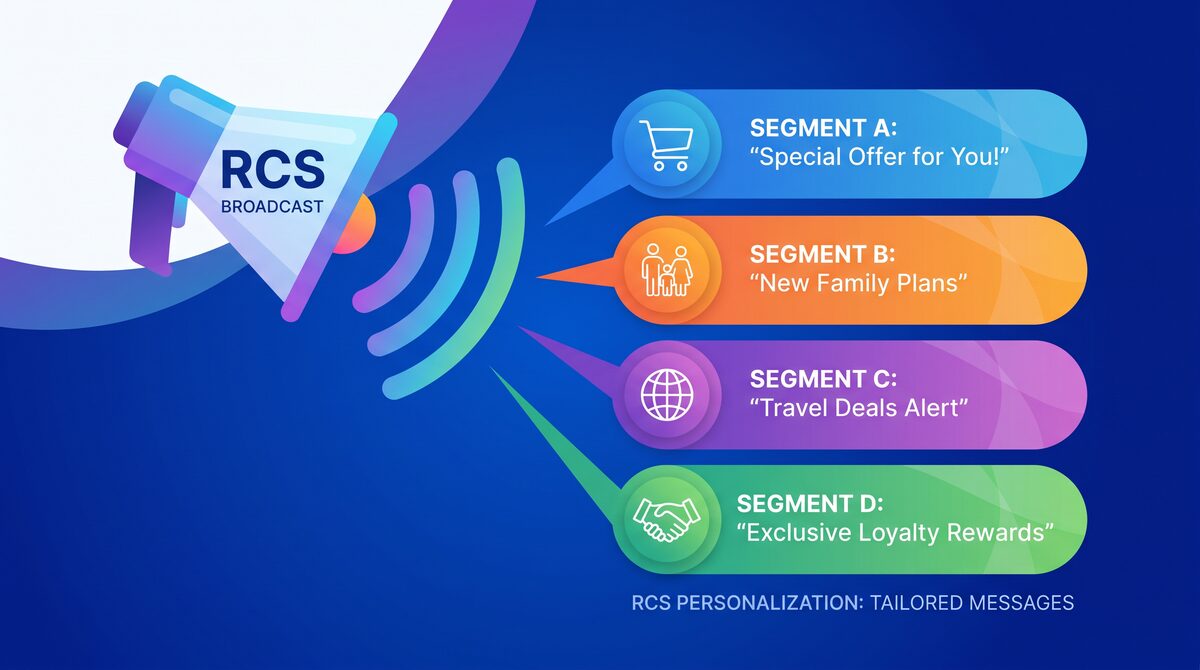
Practical Personalization Examples
E-Commerce: The Product Recommendation
Unpersonalized RCS: "Check out our bestsellers!" (Shows generic top 5 products) CTR: 6%
Personalized RCS: "Based on your interest in winter coats, check out these new arrivals" (Shows coats similar to what they browsed) CTR: 18%
Hyper-personalized RCS: "You've looked at wool coats. These just arrived in the colors you like. First-time buyer of winter coats? 20% off." (Shows specific colors they browsed, different offer based on whether they've bought before) CTR: 25%
The difference is using data you already have about that specific customer.
Retail: The Inventory Check
Unpersonalized: "Items in stock at all locations" (Shows generic inventory) Foot traffic: 2-3%
Personalized: "The jacket you loved is in stock at your nearest store" (Shows the specific item they viewed, closest location) Foot traffic: 12-15%
Subscription: The Re-Engagement
Unpersonalized: "Come back for 20% off" (Same offer to everyone) Reactivation: 3%
Personalized: "You loved our specific product category. We just launched new product in that category. Come back for 30% off your first purchase" (References their specific interests) Reactivation: 9%
Hyper-personalized: "You loved specific product. Here's your exclusive 40% off link, valid for 48 hours only" (Scarcity + personalized reference + higher discount for VIPs) Reactivation: 18%
The Personalization Workflow
Here's how to actually implement this:
Step 1: Identify segments (Day 1) Define your key segments (based on layer 1 above):
- High-value customers
- First-time buyers
- Lapsed customers
- Device type
- Location
Step 2: Define offers per segment (Week 1) What's the right offer for each segment?
- High-value: Premium products, exclusive access, VIP perks
- First-time: Discounts, social proof (reviews), assurance (guarantee)
- Lapsed: Discounts, "we miss you," exclusive comeback offer
- Android RCS: Rich experience
- iPhone: Simplified experience
Step 3: Create templates (Week 1-2) Build RCS message templates for each segment:
- Template A: High-value customer, product recommendation
- Template B: First-time buyer, new collection with discount
- Template C: Lapsed customer, win-back offer
- Etc.
Step 4: Set up data feeds (Week 2-3) Connect your data sources to your RCS platform:
- Connect e-commerce platform to pull recent purchase data
- Connect analytics to pull browsing data
- Connect CRM to pull engagement history
- Etc.
Step 5: Map data to variables (Week 3) In each RCS template, pull in dynamic data:
- {CUSTOMER_NAME} - pulled from CRM
- {RECENT_PRODUCT_CATEGORY} - pulled from browsing history
- {DISCOUNT_AMOUNT} - varies by segment
- {NEAREST_STORE} - calculated from geolocation
Step 6: Test and launch (Week 4)
- Send to small test segment first
- Measure engagement vs. baseline
- Tweak based on results
- Expand to full audience
Advanced: Dynamic Content Blocks
Instead of pre-built templates, use dynamic content blocks:
IF customer_segment == "high_value" THEN
  show_premium_products()
ELIF customer_segment == "new_customer" THEN
  show_best_sellers_with_discount()
ELIF customer_segment == "lapsed" THEN
  show_winback_offer()
END

IF recency_in_days < 7 THEN
  show_care_instructions()
ELIF recency_in_days > 180 THEN
  show_replenishment_recommendation()
END
This lets you use one message template but with different content based on customer attributes.
Personalization Pitfalls
Over-personalization: Customers can feel creeped out if you know too much. "We noticed you clicked this shoe on our website, then checked it on a competitor, then came back to ours. Here's 15% off specifically on that shoe."
That's too much. Stick to obvious personalization (purchase history, browsing, basic demographics).
Inaccurate data: If your personalization is based on wrong data, it backfires. "You loved winter coats" sent to a summer customer. Data quality is essential.
Same personalization for everyone: If everyone gets a "personalized" message with just their name changed, that's not personalization. Make the core content personal, not just the name field.
Spammy personalization: "We saw you didn't open our last email. Here's another message." Feels pushy. Don't over-explain that you're personalizing.
Ignoring privacy: Make sure you have permission to use their data this way. Explain what you're doing. Respect opt-outs.
Measuring Personalization Impact
Track these metrics to understand if personalization works:
Engagement lift:
- Generic message CTR: 6%
- Personalized message CTR: 15%
- Lift: 150%
Conversion lift:
- Generic message conversion: 1%
- Personalized message conversion: 2.5%
- Lift: 150%
Segment performance:
- Which segments respond best to personalization?
- Are there segments where personalization doesn't help?
- Use that to refine approach
Frequency tolerance:
- Do personalized messages maintain engagement over time?
- Can you message personalized audiences more frequently?
- Does personalization increase opt-out risk? (Usually decreases it)
The Bottom Line
Personalization in RCS isn't about complexity. It's about using data you already have to send more relevant messages.
Start simple:
- Segment by purchase history
- Segment by engagement level
- Send different messages to different segments
That alone will double your engagement rates.
Then iterate to layer 2 (behavioral data) and layer 3 (predictive) as you mature.
RCS's power comes from the ability to send the right message to the right person at the right time. Personalization is how you actually execute that.
Ready to start personalizing your RCS messages?
Find out if you're ready for RCS
Take our free 5-minute readiness assessment and get personalized recommendations for your business.
Tim Mushen
Experienced RCS messaging specialists sharing insights and best practices.
Related Articles

Strategy
RCS Adoption Challenges - And How to Overcome Them
Overcome carrier delays, fragmentation, and cost objections—practical fixes for marketers and operators planning an RCS rollout.
Strategy
RCS Best Practices - What Actually Works
Proven RCS frequency, timing, and content practices for marketers—what works, what to avoid, and how to scale when you're ready.