
RCS Engagement Metrics That Actually Matter

RCS Engagement Metrics That Actually Matter
I've noticed something in my conversations with business leaders about RCS: everyone wants to track "the metrics." But when I ask which metrics matter for their specific business, there's usually a pause.
Here's the reality—there are a lot of metrics you could track. But there are only a handful that actually tell you whether your RCS strategy is working.
Let me walk you through which ones matter and what healthy benchmarks look like.
The Core Metrics: What to Actually Watch
Delivery Rate
This is the baseline. What percentage of your RCS messages actually get delivered? On RCS-capable devices, you should see 95%+ delivery rates. If you're seeing anything significantly lower, you've got a technical problem to solve.
Why it matters: You can't engage with someone if the message doesn't reach them. Delivery rate is about system health.
What to watch for: Sudden drops in delivery rate (which might indicate a platform issue) or unexpected failures for specific carriers or regions (which might indicate an audience problem).
Open/Read Rate
In RCS, "open" typically means the message was read. This is more meaningful than SMS because RCS delivers read receipts automatically.
SMS gets 20-40% open rates. RCS typically achieves 50-80%. But here's what matters: your number compared to your historical baseline and your industry peers.
E-commerce typically sees 60%+ open rates on RCS. Financial services might see 75%+. Retail promotions might see 55%+. These vary because the message types, frequency, and audiences are different.
Why it matters: Open rate tells you whether people are even seeing your messages. If your open rate is dropping, something's off—could be message frequency, content relevance, timing, or audience interest.
Click-Through Rate (CTR)
This is where engagement gets real. What percentage of people who received your message actually tapped on something within it?
SMS CTR is typically 2-5%. RCS CTR for the same message usually jumps to 8-15%, sometimes higher. But the important part is the lift. Are your RCS messages getting clicked at a higher rate than SMS?
Track CTR separately by:
- Message type (promotional, transactional, informational)
- Audience segment
- Time of day sent
- Content format (carousel vs. single image vs. form)
Why it matters: CTR tells you whether people find your message interesting and actionable. A declining CTR on otherwise healthy open rates means your content or offer isn't resonating.
Response Rate
This is RCS-specific. How many people are actually responding to your messages with buttons, forms, or reply messages?
SMS response rates are typically 1-3%. RCS response rates often hit 5-10% or higher. The reason: RCS makes it easier to respond without leaving the messaging app.
Why it matters: Response rate is a leading indicator of engagement quality. When people respond, they're not passively receiving; they're actively participating. This is a sign of strong messaging strategy.
Conversion Rate
The ultimate metric. Did the message actually drive the business outcome you wanted?
RCS conversion rates vary wildly by industry and use case:
- E-commerce product recommendations: 2-8%
- Appointment confirmations: 5-15%
- Survey responses: 10-20%
- Support ticket escalation: 8-12%
But what matters is comparing your RCS conversion rate to your SMS baseline. You should see a meaningful lift—at least 50% higher, often 100-200% higher.
Why it matters: Conversion rate is what drives business value. Everything else is leading indicator; this is the actual outcome.
Metrics That Are Less Useful (But People Track Anyway)
Message Volume
Some teams get excited about the total number of messages sent. This doesn't matter much. Sending more messages usually means fewer engaged people. What matters is quality of engagement per message sent.
Cost Per Engagement
This can be useful if you're comparing channels (RCS vs. email vs. SMS), but in isolation, it's less meaningful. Yes, RCS might cost 10-20% more per message than SMS. But if it drives 100% more engagement, that cost per engagement is actually lower.
Unsubscribe Rate
Monitor this for compliance and audience health, but don't obsess. A higher unsubscribe rate on RCS sometimes just means people are actually reading and responding to the message (including unsubscribe). This can be healthier than SMS where people ignore it.

Benchmarks by Industry
I've compiled benchmark ranges from real client implementations:
E-Commerce:
- Open Rate: 55-70%
- CTR: 10-18%
- Response Rate: 6-12%
- Conversion Rate: 2-6%
Hospitality & Travel:
- Open Rate: 65-75%
- CTR: 12-20%
- Response Rate: 8-15%
- Conversion Rate: 3-8%
Retail:
- Open Rate: 50-65%
- CTR: 8-14%
- Response Rate: 5-10%
- Conversion Rate: 2-5%
Financial Services:
- Open Rate: 70-80%
- CTR: 15-22%
- Response Rate: 10-18%
- Conversion Rate: 4-10%
Healthcare:
- Open Rate: 60-75%
- CTR: 10-16%
- Response Rate: 8-14%
- Conversion Rate: 3-8%
These benchmarks assume:
- Well-targeted, relevant messages
- Reasonable message frequency (not spammy)
- Optimized timing (not 3 AM)
- Quality content (actual value, not just promotions)
If you're below these ranges, that's okay—there's improvement opportunity. If you're above, you're doing something right. If you're way above, you might want to check whether your metrics are being calculated correctly.
The Metrics That Reveal Problems
Engagement Drop-Off Over Time
This is the one nobody likes to talk about. You launch RCS. First week, everything looks great. But then over the following weeks, your open and response rates start declining.
Common causes:
- You're messaging too frequently (frequency fatigue)
- Your content quality dropped (you're being lazy after launch)
- You're messaging the wrong people (poor segmentation)
- Your timing is off (sending at bad times for your audience)
The fix: Don't just watch overall metrics. Segment by cohort (people who opted in week 1 vs. week 2, etc.) and see where the drop-off happens. That tells you whether it's a message fatigue problem or a content problem.
Platform-Specific Issues
RCS works across Android, but there are variations by manufacturer and carrier. You might see:
- Lower open rates on specific carriers (Deutsche Telekom vs. Verizon)
- Form submission failures on older Android versions
- Image rendering issues on certain manufacturers
This is rare, but it happens. If you notice consistent issues with specific user segments, mention it to your platform provider.
Conversion That Doesn't Match Engagement
Sometimes you see high open and click rates but low conversion. This usually means:
- The offer isn't compelling (they click to see but don't buy)
- The friction between message and transaction is too high (requires too many steps)
- Your audience segment is wrong (you're reaching interested but non-buying customers)
- Your call-to-action is unclear
The fix: Analyze the customer journey from message click to conversion. Where do people drop off? That's your optimization point.
Setting Up Proper Tracking
You need to track these metrics consistently. Here's the infrastructure I recommend:
At minimum:
- RCS platform provides delivery, open, and click tracking natively
- Tag each message with campaign, audience segment, and message type
- Capture conversion data in your business systems (e-commerce platform, CRM, etc.)
- Create monthly reporting that compares RCS to your SMS baseline
Better:
- Set up a data warehouse that consolidates RCS metrics with conversion data
- Create dashboards showing metric trends over time
- Segment analysis by audience, message type, time of day, etc.
- Set up alerts when metrics move unexpectedly
Best:
- All of the above plus:
- A/B testing framework for message content, timing, and format
- Attribution modeling to understand RCS's role in overall customer journey
- Predictive modeling to optimize send times and audiences
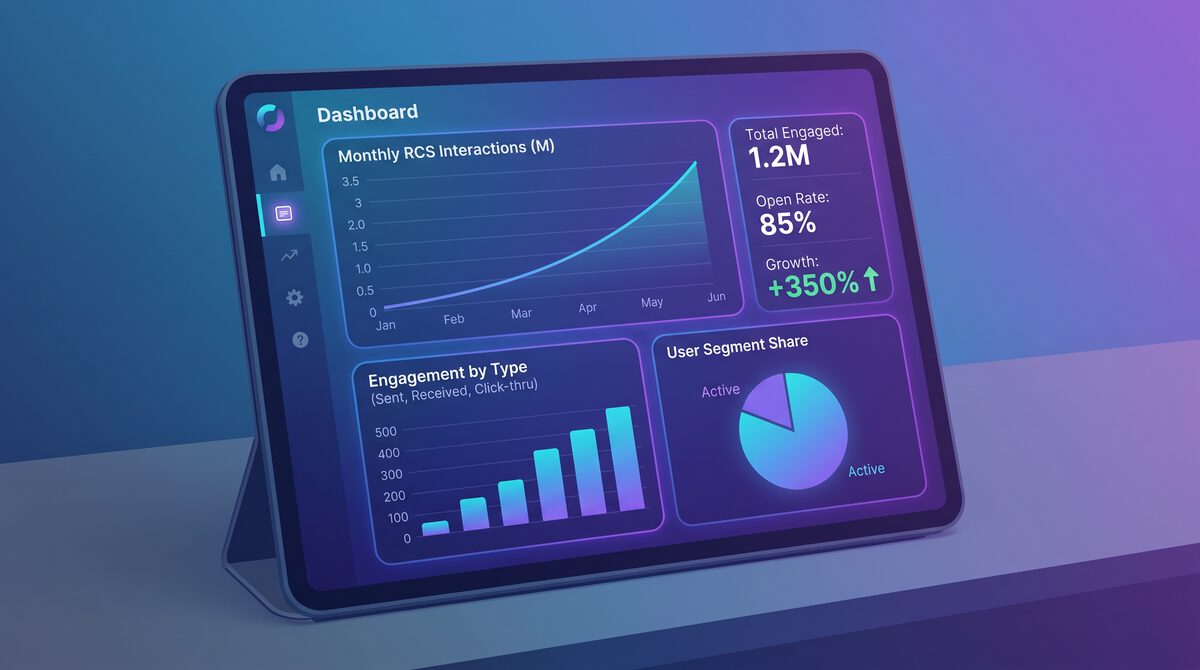
The Actionable Metrics Dashboard
If you're building a dashboard from scratch, I'd focus on these six metrics:
- Weekly Open Rate Trend - Shows engagement momentum
- Week-over-Week Conversion Lift - Shows RCS impact vs. baseline
- Segment Performance - Which audience segments are performing best?
- Message Type Performance - What kind of messages work best?
- Optimal Send Time - When do your specific customers engage most?
- Cost Per Conversion - RCS vs. SMS comparison
Track these weekly, benchmark against your targets and industry standards, and use them to guide optimization.
The Mistakes I See Teams Make
Over-optimizing early: You send five RCS campaigns. Four have great metrics, one doesn't. You don't touch that message type anymore. Actually, try a couple more variations. One data point isn't enough.
Chasing the wrong metrics: "We need to maximize message volume!" That's the wrong goal. You want to maximize return per message, not total messages.
Not comparing to baseline: You launch RCS and get excited about the metrics. But compared to what? If you're not comparing RCS CTR to SMS CTR from the same audience, you don't know if you're actually winning.
Ignoring sample size: Your new niche audience segment shows incredible RCS metrics (15% conversion). Great! But you're sending to 500 people. That's 75 conversions—good, but not statistically significant. Before investing heavily in that segment, test it at scale.
Metric fatigue: You start tracking everything. Open rate, click rate, response rate, response time, sentiment of responses, phase of the moon... This doesn't help. Pick your core metrics. Track them consistently. Ignore the noise.
Moving From Metrics to Action
At the end of the day, metrics are only valuable if they drive decisions. Here's how I think about it:
- Healthy metrics = Keep doing what you're doing, but optimize small details
- Declining metrics = Something's changed (frequency, content, timing, audience). Find and fix it.
- Lagging metrics = The strategy itself might need adjustment (different message type, different segment, different offer)
- Exceptional metrics = You've found something that works. Test at scale.
The trap is getting so focused on the metrics themselves that you forget what they're for: understanding whether your RCS strategy is actually delivering business value.
If your open rates are perfect but your conversions are flat, you need a different strategy, not better metrics.
If your response rates are declining but conversion is steady, your messaging might be over-engaging but your offers are solid.
The metrics are the map. The business outcomes are the destination. Keep both in focus.
Ready to set up proper tracking for your RCS program?
Find out if you're ready for RCS
Take our free 5-minute readiness assessment and get personalized recommendations for your business.
Tim Mushen
Experienced RCS messaging specialists sharing insights and best practices.
Related Articles

Strategy
RCS Adoption Challenges - And How to Overcome Them
Overcome carrier delays, fragmentation, and cost objections—practical fixes for marketers and operators planning an RCS rollout.

Strategy
RCS Best Practices - What Actually Works
Proven RCS frequency, timing, and content practices for marketers—what works, what to avoid, and how to scale when you're ready.