
The Future of Business Messaging is RCS

The Future of Business Messaging is RCS
I've been in the messaging space for years, and I've watched SMS dominate for so long that people assumed it would always be the standard. But that's ending. The future is RCS, and it's closer than most people think.
Here's where I see this heading and what you need to do about it.
Where RCS is Heading
Adoption Acceleration
RCS adoption is currently 40%+ in developed markets and growing 40% annually. By 2026, I expect we'll hit 60%+ in the US and Europe.
Why? Because:
- Carriers have invested billions in infrastructure
- Device manufacturers are prioritizing RCS
- Enterprise adoption is driving consumer adoption
- Network effects: as more businesses use RCS, customers demand it from others
This isn't linear growth. It accelerates as network effects kick in.
Feature Expansion
RCS today is mostly text, images, buttons, and carousels. But the spec allows for much more:
Video calling: Native video calls within RCS, not just phone calls Payments: Complete transactions without leaving the message Location services: Real-time location sharing, store directions AR elements: Augmented reality try-on, product visualization Interactive surveys: Full-featured surveys inline Chatbot integration: Natural language understanding and responses
Most of these are coming within 2-3 years. Early adopters will have massive advantages.
Platform Evolution
RCS will evolve from "messaging platform" to "business communication platform":
- CRM integration: Your RCS messages pull data from your CRM in real-time
- Loyalty integration: Earning and redeeming points happens in RCS
- Inventory integration: Stock levels, availability shown in real-time
- Payment integration: Buy directly in RCS with saved payment methods
This transforms RCS from a notification channel to a complete business platform.
Global Expansion
RCS is strong in North America, Europe, and parts of Asia. But it's still emerging in:
- Latin America
- Middle East
- Southeast Asia
- Africa
Over the next 3-5 years, these regions will see RCS adoption explosion as they leapfrog SMS like they leapfrogged landlines.
What This Means for Your Business
Competitive Advantage Window
Right now, most businesses haven't adopted RCS. That's your window to build competitive advantage.
In 2-3 years, RCS adoption will be standard. Every competitor will be using it. You won't be able to differentiate on RCS alone.
But if you build RCS excellence now, you'll have:
- Better customer relationships
- Stronger engagement metrics
- Data on what works with your audience
- Operational efficiency from automation
- Brand reputation as innovative
Do this now, and by the time it's table stakes, you're already winning.
Customer Expectations Shift
Right now, if you send SMS, most customers expect it. If you send RCS, it feels premium.
In 2-3 years, RCS will feel normal. Customers will expect rich, interactive messages. SMS will feel outdated (like it does from many businesses today).
Get ahead of this shift. Start training your customers on RCS now. By the time it's standard, your best customers are already expecting it from you.
Technology Investment
RCS-focused technology is maturing. New tools are emerging:
- Better RCS-native design tools
- AI-powered message optimization
- Advanced personalization engines
- RCS-specific analytics platforms
- Integration platforms
The technology that seems cutting-edge now will be standard in 2 years. Invest in platforms that will evolve with the market, not ones that will be outdated.
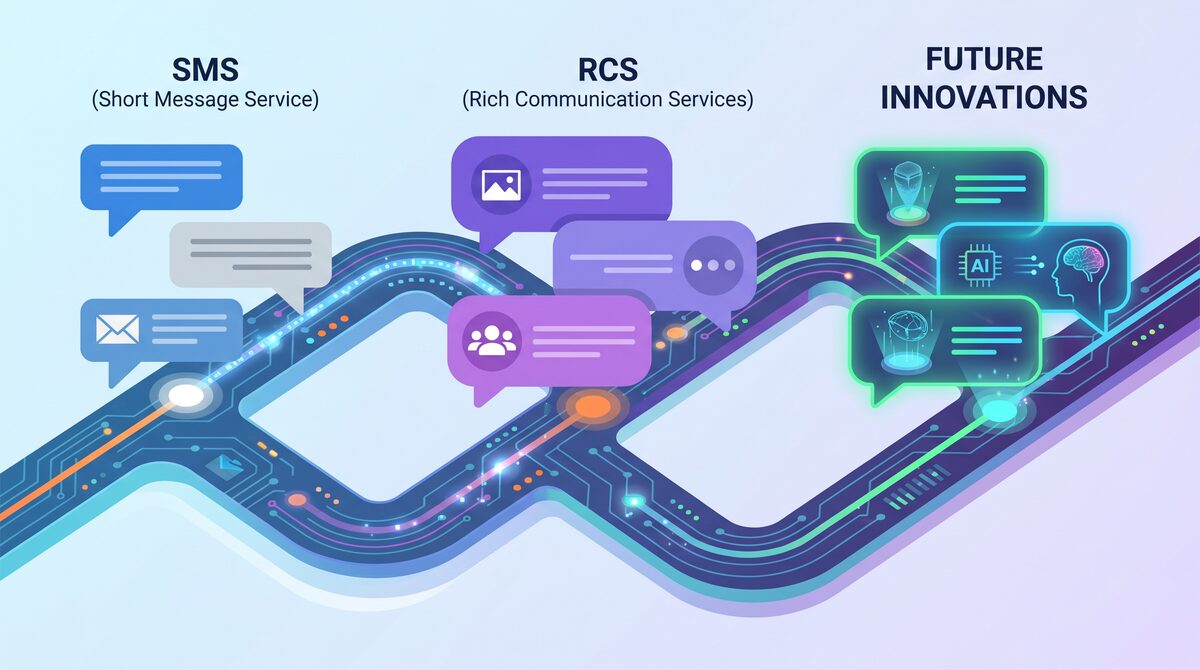
The Inevitable SMS Decline
This is the controversial take, but I believe it: SMS will decline over the next 5-10 years.
Not disappear—it'll still exist for critical alerts and universal reach. But as a business communication channel? It'll be like fax is today. Technically available, but nobody wants to use it.
Why?
- Experience gap: RCS is objectively better. Once people experience RCS, SMS feels limiting.
- Youth don't expect SMS: Teenagers and young adults grew up with iMessage, WhatsApp, etc. Plain text SMS doesn't excite them.
- International trends: Other markets are skipping SMS entirely. They go straight to RCS or messaging apps.
- Carrier incentive: Carriers make more money from RCS than SMS. They'll continue pushing adoption.
By 2030, I expect SMS will be <30% of business messaging (down from ~70% today). RCS will be primary for engagement and conversion. Messaging apps (WhatsApp, WeChat, etc.) will handle customer service.
What to Do Right Now
1. Start RCS Implementation
If you haven't already, start building your RCS strategy and implementation now. You don't need to be perfect. Just begin.
The cost of starting is low. The cost of being late is high.
2. Build Your Data Infrastructure
RCS's future value depends on personalization. Personalization depends on data.
Start consolidating your customer data now:
- E-commerce behavior
- CRM interactions
- Email engagement
- Support history
- Purchase patterns
Build the infrastructure to unify this data. Use a CDP if you don't have one. Make personalization the foundation of your RCS strategy.
3. Invest in Messaging Expertise
Your SMS person might not be your RCS person. RCS requires different thinking:
- Rich media design
- Personalization strategy
- Two-way conversation handling
- Interactive element optimization
Start building this expertise now, whether through hiring, training, or consulting.
4. Prepare Your Team
Your customer service, marketing, and operations teams need to understand RCS's role in your business:
- How it impacts customer experience
- What it enables operationally
- How to integrate it with existing processes
Train them now. Don't wait until you've implemented.
5. Choose the Right Platform
Not all RCS platforms are equal. Some are SMS platforms with RCS bolted on. Some are true RCS platforms.
Look for:
- Genuine RCS expertise (not just SMS sales saying "we do RCS now")
- Integration with your existing systems
- Scalability roadmap
- Advanced personalization features
- Strong support and training
This partnership matters long-term. Choose well.
6. Plan for Global
Even if your business is domestic now, RCS is going global. Countries roll out RCS at different times. Carriers have different requirements.
Start planning international RCS strategies now. Don't assume US/EU patterns apply everywhere.
The Three-Stage Future
Stage 1 (Now - 2025): RCS as competitive advantage
- Early adopters gain significant advantage
- RCS is premium, exciting, differentiating
- SMS still the standard; RCS is the surprise
Stage 2 (2025-2027): RCS becomes standard
- Adoption hits 60%+ in developed markets
- Customers expect RCS from premium brands
- Businesses that haven't adopted are at a disadvantage
- RCS-plus-SMS strategies fully mature
Stage 3 (2027-2030): RCS is default, SMS is legacy
- RCS is the primary business messaging channel
- SMS is for critical alerts only
- Customers prefer and expect RCS
- Businesses still using only SMS are competitive disadvantage
The Wild Card: Messaging Apps
I'd be remiss not to mention: WhatsApp, WeChat, Telegram, etc. are growing rapidly for business messaging.
In some markets (Southeast Asia, parts of Europe, Latin America), messaging apps are already primary for business-to-customer communication.
This doesn't mean RCS fails. It means:
- RCS dominates in North America, parts of Europe
- Messaging apps dominate in other regions
- Smart businesses use multiple channels based on geography
The future isn't "RCS wins everything." It's "RCS wins in developed markets; messaging apps win elsewhere; SMS becomes universal fallback."
Preparing for Uncertainty
The future isn't 100% certain. What if Apple finally adopts RCS natively? (This would accelerate everything 2 years.) What if a new platform emerges? (Unlikely, but possible.)
How do you prepare for uncertainty?
- Don't bet everything on RCS. Build a multi-channel strategy.
- Stay flexible. Choose platforms and vendors that can evolve, not ones locked into one channel.
- Focus on fundamentals. Good customer communication, personalization, respect for preferences—these work across all channels.
- Monitor the landscape. Stay aware of technology trends. Don't get surprised.
- Test and learn. Try new channels in small ways. See what works for your audience.
The Conversation Changes
Right now, the conversation is "Should we use RCS?"
In 2 years, it will be "How do we optimize our RCS strategy?"
In 4 years, it will be "Why are we still using SMS?"
You want to be ahead of those shifts, not behind them.
Final Thought
RCS represents a generational shift in business-to-consumer communication. It's not hype. It's infrastructure. Carriers have invested billions. Devices are ready. Customers are adopting.
The question isn't whether RCS is the future. It is.
The question is: are you going to lead that future for your business, or follow it?
The time to decide is now.
Ready to build the future of your business messaging today?
Find out if you're ready for RCS
Take our free 5-minute readiness assessment and get personalized recommendations for your business.
Tim Mushen
Experienced RCS messaging specialists sharing insights and best practices.